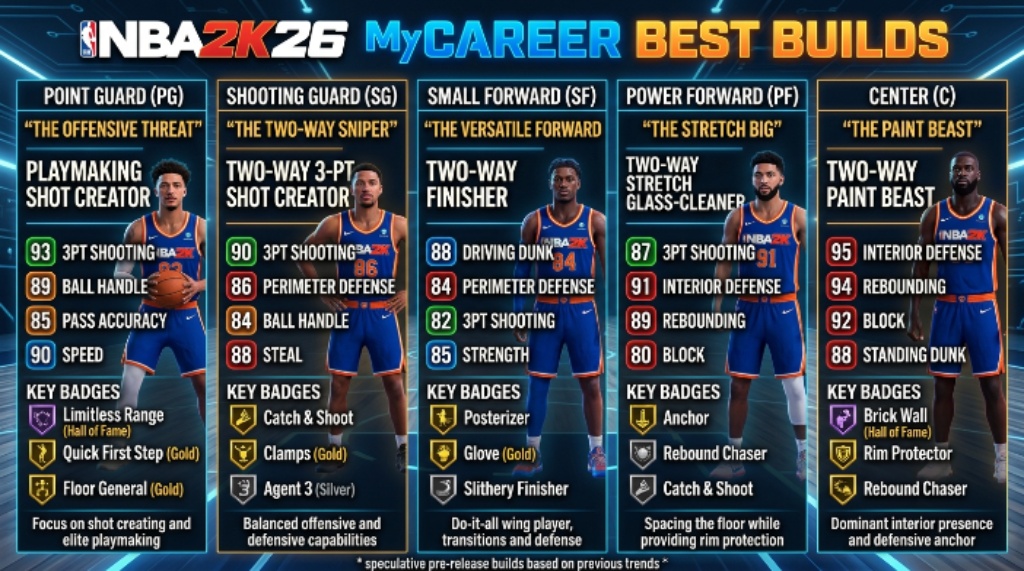
NBA 2K26 is one of the most popular basketball games in the US right now. Millions of players dive into MyCareer mode every season hoping to build the perfect player. However, with so many options available, choosing the right build can feel overwhelming. This guide breaks down the best builds for every position — point guard, shooting guard, small forward, power forward, and center. Whether you want to shoot threes, lock down opponents, or dominate the paint, there is a build here for you.
Why Your Build Choice Matters in MyCareer
Your build is the foundation of everything in MyCareer. It determines how you play, what badges you earn, and how effective you are in Park, Rec, and Pro-Am. Therefore, taking time to plan your build before spending Virtual Currency is always a smart move.
The MyPLAYER Builder in NBA 2K26 now includes a Build Specialization system. This lets you deepen your player’s skills in one specific area such as finishing, shooting, playmaking, defense, or rebounding. Each path offers unique rewards and cap breakers. Additionally, the new Animation Glossary makes it easy to see exactly what attribute levels you need for any animation in the game.
Getting your build right from the start saves you time, VC, and frustration down the road.
Quick Build Overview by Position
Here is a snapshot of the top recommended build for each position to help you decide where to start.
| Position | Best Build Name | Height | Key Strengths | Best Mode |
| PG | Unlimited Range Point Guard | 6’2″ | Deep shooting, playmaking | Park, 3v3 |
| SG | Two-Way 3PT Shot Hunter | 6’5″ | Elite shooting and defense | Park, Rec |
| SF | Lockdown Wing | 6’8″ | Perimeter defense, versatility | Pro-Am |
| PF | Stretch Big | 6’11” | Floor spacing, rim protection | Rec, Pro-Am |
| C | Facilitating Center | 7’0″ | Passing, rebounding, interior defense | 5v5 modes |
Point Guard: Unlimited Range Floor General
The point guard position is all about controlling the game. You need speed, ball handling, and the ability to score when your team needs it. The Unlimited Range Point Guard build checks every box.
This build stands at 6’2″ and prioritizes three-point shooting above all else. A three-point rating in the mid-nineties combined with elite ball handling makes this player nearly impossible to guard from the perimeter. Your speed rating sits in the low nineties, allowing you to get to your spots quickly and create separation.
The real strength of this build is spacing the floor. When you pull from deep range, defenders have to come out to guard you. That opens driving lanes for your teammates. Additionally, with a pass accuracy rating in the low nineties, you can find the open man with ease when help defenders collapse.
Key strengths to invest in for this build:
- Three-point shooting as your primary attribute
- Ball handling for dribble moves and creating your own shot
- Pass accuracy to keep your teammates involved
- Speed and acceleration to stay ahead of defenders
This build performs best in 3-on-3 Park settings where spacing is everything. However, it also works well in 5-on-5 Rec when you have bigs who can catch lobs and finish at the rim.

Shooting Guard: Two-Way 3PT Shot Hunter
The shooting guard position in NBA 2K26 rewards players who can do two things well — score from the outside and guard the other team’s best perimeter scorer. The Two-Way 3PT Shot Hunter does both at a very high level.
At 6’5″ with a long wingspan of around 6’10”, this build stretches the floor on offense while creating havoc on defense. The three-point rating sits in the low nineties, and the perimeter defense rating matches it closely. This balance makes you a threat on both ends of every possession.
The extended wingspan is a key feature of this build. It helps you contest shots without fouling, reach into passing lanes for steals, and finish over shorter defenders when you attack the basket. Therefore, do not sacrifice wingspan when creating this build — it is worth every attribute point.
This build excels in catch-and-shoot situations. Move without the ball, get open off screens, and knock down the open three. On defense, use your length and lateral quickness to stay in front of opposing guards. Your defensive ability will also help your team create fast break opportunities after steals.
Small Forward: Lockdown Wing Defender
The small forward is arguably the most important defensive position on the court in competitive play. Teams that win in Pro-Am and high-level Rec almost always have a dedicated lockdown defender at the three. The Lockdown Wing build is built exactly for that role.
Standing at 6’8″ with a wingspan pushing past seven feet, this build has the physical tools to guard point guards, shooting guards, and even some power forwards. Perimeter defense reaches the mid-nineties, and steal and block ratings both sit in the high eighties.
Offense is not ignored, however. A driving dunk rating in the low eighties means you can still finish at the rim. A three-point rating in the high seventies lets you knock down open shots when defenders sag off to help on your teammates. Therefore, this build is not just a one-dimensional stopper — it contributes on offense too.
Additionally, the Lockdown Wing thrives in Pro-Am where team communication and defensive assignments matter most. Your job is to take away the opposing team’s best scorer and limit their offensive opportunities. When you do that consistently, your team wins more games.
Power Forward: Stretch Big Floor Spacer
The power forward position has changed dramatically in modern basketball. Today’s best fours can shoot from the perimeter, defend multiple positions, and rebound at a high level. The Stretch Big build captures all of that.
At 6’11” with a wingspan above seven feet, this build brings size and length to every matchup. The three-point rating sits at 85, which is high enough to keep opposing bigs from sagging into the paint. Mid-range shooting is even stronger, giving you reliable scoring in the short corner and elbow areas.
Interior defense and rebounding ratings both sit in the mid-to-high eighties, meaning you can hold your own in the paint against traditional bigs. Additionally, a free throw rating close to 96 makes this build extremely reliable in late-game situations when fouling is intentional.
Here is a comparison of the two main power forward build styles to help you choose:
| Build Style | Best For | Shooting | Interior Defense | Rebounding |
| Stretch Big | Floor spacing, switching | 85 three-point | 86 interior | 84 boards |
| Glass Cleaning Finisher | Paint scoring, offensive boards | 70 three-point | 85 interior | 90 offensive |
Choose the Stretch Big if your team already has a traditional center who can protect the paint. Choose the Glass Cleaning Finisher if you need more physicality and second-chance points.
Center: Facilitating Big Man
Centers in NBA 2K26 have more variety than ever before. The Facilitating Center build takes a unique approach by combining traditional big man skills with elite passing ability.
At 7’0″ with a wingspan around 7’4″, this build protects the rim, controls the boards, and starts fast breaks with accurate outlet passes. What makes this build special is its pass accuracy rating in the high eighties — extremely rare for a player of this size. Pair that with a rebounding rating of 90 and interior defense in the high eighties, and you have a center who does everything a winning team needs.
The three-point rating sits at 77, which is just enough to pull opposing centers away from the basket. When defenders sag off, you can knock down the open shot. However, your primary value is not scoring — it is controlling the game from the paint and finding teammates in transition.
Additionally, this build works especially well in organized 5-on-5 settings where players communicate and run structured offense. When your center can trigger fast breaks with a single pass, your whole team moves faster and scores easier.

Choosing Your Build Based on Game Mode
Not every build works equally well in every setting. Therefore, it helps to think about where you plan to spend most of your time before committing to a build.
| Game Mode | Best Position Picks | Why |
| 3-on-3 Park | PG, SG | Spacing and speed dominate |
| 5-on-5 Rec | SF, PF, C | Balanced teams win more |
| Pro-Am | Lockdown SF, Two-Way SG | Defensive discipline required |
| MyCareer Story | Any position | Play to your personal style |
If you enjoy playing with random teammates in Rec, prioritize a build that is self-sufficient and can contribute without requiring perfect team play. If you play with a regular crew in Pro-Am, communication and role specialization become more important.
Tips for Building Your MyPLAYER Effectively
Getting the most out of your build requires more than just picking the right attributes. Here are some practical tips to help you succeed.
- Plan your badge requirements before spending any Virtual Currency. Know which badges you want at Hall of Fame tier and make sure your attributes support them.
- Use the Animation Glossary to confirm that your height and attribute levels unlock the animations you want before you finalize the build.
- Join a crew early. Crew progression rewards you with additional cap breakers at higher levels, which allow you to push key attributes beyond their initial limits.
- Focus on your build’s primary skill first. Upgrade your main attribute category before spreading points across secondary areas.
- Complete the Build Specialization questline for your chosen skill area. These quests reward cap breakers and exclusive badge perks that give you a lasting advantage.
Conclusion
Choosing the right MyCareer build in NBA 2K26 sets the tone for your entire experience. The Unlimited Range Point Guard dominates from the perimeter, the Two-Way 3PT Shot Hunter excels at both ends for shooting guards, the Lockdown Wing anchors team defense at small forward, the Stretch Big brings modern versatility at power forward, and the Facilitating Center revolutionizes how the five position impacts the game. Each build is designed to maximize your impact in specific situations and game modes.
Take time to plan your build, understand your role within your team, and invest your Virtual Currency wisely. Success in MyCareer comes from mastering your playstyle and understanding what your team needs from you in every game.
Frequently Asked Questions
What is the best overall MyCareer build in NBA 2K26?
The Two-Way 3PT Shot Hunter at shooting guard is widely considered the best all-around build in the current meta. It combines elite perimeter shooting with lockdown defense, making it useful in every game mode including Park, Rec, and Pro-Am.
How tall should my point guard build be in NBA 2K26?
Most competitive point guard builds range from 6’2″ to 6’5″. Shorter builds move faster and unlock quicker animations, while taller builds offer defensive advantages. The 6’2″ height is the most popular choice for pure shooting-focused point guards.
Can I change my build after I create it in MyCareer?
No, builds are permanent once you confirm and create them. However, the Rebirth system allows you to start a new build with accelerated progression based on the overall rating you reached on a previous player. Planning carefully before creation is always the best approach.
What are cap breakers and why do they matter?
Cap breakers are special rewards earned through quests, crew progression, and seasonal content. They allow you to push certain attributes beyond their original maximum limit. This is important because higher attributes unlock Hall of Fame and Legend tier badges that give you a significant advantage over other players.
Which position earns Virtual Currency the fastest in MyCareer?
Centers and power forwards generally earn more experience and Virtual Currency per game because of the higher opportunity to rack up rebounds, blocks, and interior scoring. If grinding for VC is your priority, a big man build focused on rebounding is one of the most efficient choices.